Ashgabat: the Capital of Turkmenistan, City of White Marble
Ashgabat, the capital city of Turkmenistan, is a mesmerizing blend of architectural grandeur, cultural richness, and vibrant energy. Situated at the crossroads of Central Asia, Ashgabat showcases a fascinating mix of ancient traditions and modern development.
Imagine a capital built between a desert and a mountain range, where entire avenues gleam with white marble, enormous golden monuments rise above immaculate parks, fountains appear in improbable numbers and one of the world's largest architectural stars watches over the city from a 211-metre television tower.
Then imagine that this is not a film set, an architectural rendering or an eccentric billionaire's private city. This is Ashgabat.
The capital of Turkmenistan is one of those rare places that makes even experienced travellers stop trying to compare it with somewhere else. There are elements of Central Asia here, certainly, but Ashgabat belongs largely to its own category. It is monumental yet remarkably quiet, traditional yet strikingly futuristic, meticulously landscaped yet surrounded by the vast landscapes of southern Turkmenistan. At certain moments, walking through its marble districts can feel less like conventional sightseeing and more like entering an alternative version of what a capital city could be.
- Is it excessive? Absolutely.
- Is it occasionally bizarre? Without question.
- Could some of it even be called a little cringe? Perhaps.
But that is exactly why Ashgabat deserves to be experienced at least once. Because whatever else you think about it, Ashgabat is almost impossible to forget.
The White City That Actually Broke a World Record
Calling Ashgabat the "White City" is not simply tourism marketing. The scale of its marble architecture is officially record-breaking.
In 2013, Guinness World Records recognised Ashgabat for the highest density of white marble-clad buildings in the world. The figures explain why the city can look almost unreal when you first arrive.
Within an area of just 22 square kilometres, Guinness recorded 543 buildings clad with 4,513,584 square metres of white marble. Put differently, that is more than 4.5 million square metres of marble concentrated into one section of the capital.
And then there is Bitarap Türkmenistan Avenue. According to Guinness World Records, the 12.6-kilometre avenue alone was lined with 170 white-marble buildings containing more than 1.15 million square metres of marble.
This is not a subtle architectural statement. It is an entire city district committing to an aesthetic with almost alarming confidence.
For visitors, the effect is immediate. Monumental white façades rise behind landscaped parks and fountains; broad avenues seem to stretch towards the Kopet Dag Mountains; gold detailing catches the intense Central Asian sun. Depending on the hour, the city can appear brilliant white, silver or almost golden.
There are cities famous for one marble palace. Ashgabat apparently looked at that concept and decided to scale it up to several hundred buildings.
A Capital That Collects World Records
The marble record would be unusual enough on its own, but Ashgabat has repeatedly appeared in Guinness World Records for its architecture and monumental projects.
One of the strangest examples is the Alem Cultural and Entertainment Centre, home to a gigantic Ferris wheel enclosed inside a glass-and-steel structure.
Guinness World Records officially lists it as the largest indoor Ferris wheel. The wheel measures 47.6 metres high, has 24 cabins, and sits inside a structure measuring approximately 57 metres in diameter.
Think about that for a moment. Someone proposed putting an enormous Ferris wheel inside a building. And Ashgabat essentially replied: make it bigger.
The result is exactly the sort of attraction that makes this city fascinating. Even when you think you have understood Ashgabat's architectural language, another building appears and changes the conversation completely.
The Giant Star Above Ashgabat
Look towards the hills south of the city and another record-breaking structure dominates the skyline: the Turkmenistan Broadcasting Centre.
The tower itself rises 211 metres, but its most extraordinary feature is the enormous eight-pointed Oguz Khan Star incorporated into its architecture.
In 2011, Guinness World Records recognised it as the largest architectural star in the world, measuring an astonishing 3,240 square metres.
The design is particularly interesting because this is not simply a giant geometric decoration. The eight-pointed star is deeply connected to Turkmen national symbolism and appears throughout the country's visual culture, from architecture and carpets to decorative motifs.
That combination says a great deal about modern Ashgabat. The city does not merely preserve traditional symbols inside museums. It takes them, enlarges them dramatically and incorporates them into contemporary architecture.
In Ashgabat, cultural symbolism does not whisper. It arrives at 3,240 square metres.
And Then There Are the Fountains
Ashgabat is located beside the Karakum Desert, which makes its obsession with water features particularly striking. Fountains appear throughout the monumental centre: beside government buildings, across parks, along major avenues and within enormous landscaped complexes. And, naturally, there is a Guinness World Record involved here too.
In June 2008, Guinness certified a fountain complex in Ashgabat for the most fountain pools in a public place: 27 synchronised and programmable fountain pools covering an area of approximately 14.8 hectares.
The contrast is part of what makes the city visually extraordinary. You are travelling through one of the driest regions of Central Asia, with the Karakum Desert occupying much of Turkmenistan, yet the capital presents visitors with landscaped gardens, carefully planted avenues and monumental fountains.
It creates another of those very Ashgabat moments when geography tells you one thing and architecture tells you something completely different.
Even the Airport Has a Guinness World Record
The surrealism begins before you properly enter the city. Ashgabat International Airport's main terminal was designed in the form of a gigantic bird with its wings spread across the landscape. From above, the structure looks almost as though it is preparing to take flight. But apparently building an airport shaped like a bird was insufficiently ambitious.
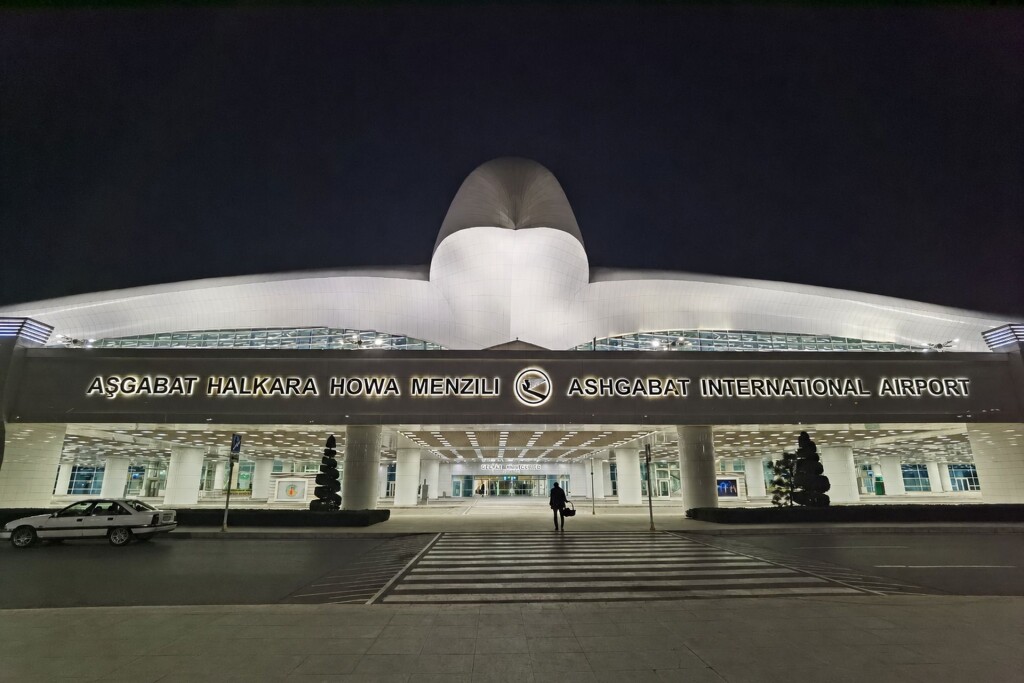
The terminal also incorporates the world's largest “gul”, a traditional Turkmen carpet motif.
Guinness World Records measured the design at 705 square metres in September 2016. The enormous motif is integrated into the roof of the terminal, transforming one of Turkmen culture's most recognisable traditional designs into a piece of monumental contemporary architecture.
It is a fitting introduction to Ashgabat.
You have not even collected your luggage and the city has already introduced you to a giant bird-shaped airport decorated with a world-record-breaking carpet motif.
Normality was never really on the itinerary.
Even Sport Had to Become Monumental
Ashgabat's enthusiasm for scale extends beyond monuments.
At the Ashgabat Olympic Complex, Guinness World Records recognised the largest aquatics sports park, measuring 4,976.65 square metres of pools when it was officially measured in 2016.
The wider Olympic complex became one of the major architectural projects associated with the city's development and later hosted the 5th Asian Indoor and Martial Arts Games in 2017.
Once again, the pattern is unmistakable.
Ashgabat does not seem particularly interested in doing things quietly.
Whether the subject is marble, fountains, entertainment centres, broadcasting towers, airports or sporting infrastructure, the city's architecture repeatedly gravitates towards scale and spectacle.
For architecture enthusiasts, photographers and travellers fascinated by unusual urban planning, this makes Ashgabat genuinely compelling.
Is Ashgabat Beautiful, Bizarre or Both?
That depends entirely on who is looking.
Some travellers are immediately fascinated by the symmetry, cleanliness and monumental architecture. Others find the enormous avenues and pristine white buildings almost surreal. Some love the futuristic appearance; others cannot quite decide whether they have entered a capital city, a science-fiction film or an architectural exhibition that somehow became permanent.
The correct response may simply be: all of the above.
And that uncertainty is precisely what makes Ashgabat interesting.
The world already has plenty of destinations that are conventionally beautiful. We know the formula: cobbled streets, charming cafés, old churches, sunset viewpoints and approximately fourteen thousand people attempting to take the same photograph.
Ashgabat offers something much rarer.
It makes you curious.
You find yourself examining buildings simply because you cannot understand why they look the way they do. You notice tiny details because the enormous scale around them seems so unusual. You begin asking your guide questions that would sound ridiculous anywhere else.
"Is that actually made of marble?"
"How tall is that?"
"Is that really a world record?"
"Why is there a Ferris wheel inside a building?"
And, remarkably often, the answer is yes.
But There Is Another Ashgabat Beyond the Marble
The biggest mistake would be to treat Ashgabat simply as a collection of extravagant modern buildings.
Behind its futuristic image lies a much older story.
Only a short distance from modern Ashgabat are the remains of Old Nisa, once an important centre of the Parthian Empire and today part of a UNESCO World Heritage Site. The contrast could hardly be stronger: within the same journey, visitors can move from archaeological remains connected to one of antiquity's great empires to avenues lined with gleaming 21st-century marble architecture.
Then there are the Akhal-Teke horses, perhaps Turkmenistan's most famous living symbol. Known for their extraordinary elegance, endurance and distinctive metallic-looking coats, these horses have been bred in the region for centuries and remain deeply connected to Turkmen identity.
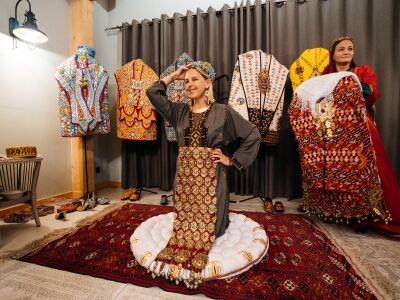
Traditional carpets, national dress, bazaars, food and hospitality reveal another side of the capital that monumental architecture alone cannot explain.
This is where Ashgabat becomes much more interesting than the photographs suggest.
It is not simply "the white marble city."
It is a place where ancient civilisation, Silk Road history, nomadic heritage, Soviet history, modern nation-building and highly ambitious contemporary architecture exist within the same urban landscape.
You May Not Love Ashgabat. That Is Not the Point.
There is a slightly exhausting tendency in modern tourism to insist that every destination must be described as "breathtaking", "hidden", "authentic" or "a must-see paradise."
Ashgabat does not need that treatment.
It is more interesting than that.
You might find it magnificent.
You might find it excessive.
You might think parts of it are elegant and other parts completely over the top.
You may occasionally laugh.
You will almost certainly take photographs.
And afterwards, you will probably try to explain the city to somebody who has never visited and discover that saying "there is a lot of white marble" does not remotely cover it.
That is the real argument for visiting Ashgabat.
Travel is not only about collecting beautiful places.
It is about encountering places that challenge your expectations of what a city, a culture or even a capital can look like.
And Ashgabat does that exceptionally well.
Come Because There Is Nowhere Quite Like It
Come to Ashgabat for the 543 white-marble buildings that helped place the city in Guinness World Records.
Come to see a 47.6-metre indoor Ferris wheel, a 3,240-square-metre architectural star, a record-breaking complex of 27 fountain pools, and an airport decorated with the world's largest gul.
Come for ancient Nisa and the Akhal-Teke horses.
Come for the mountains and the edge of the Karakum Desert.
Come to photograph a city that sometimes looks as though somebody typed "futuristic white-marble Central Asian capital, maximum budget, add gold" into an architectural generator and then actually built the result.
But most importantly, come because Ashgabat is genuinely different.
Not artificially "unique" because a tourism brochure needs an adjective.
Actually different.
In a world where international travel can sometimes feel strangely homogenised, where the same hotels, cafés, shopping streets and Instagram aesthetics follow you from continent to continent, Ashgabat remains stubbornly, spectacularly itself.
It is polished and peculiar. Ancient and futuristic. Serious and occasionally wonderfully absurd.
Ashgabat might be one of the strangest cities you ever visit.
And that may be the best reason to visit it.
Ashgabat, Turkmenistan
You have seen beautiful cities. Now come and see one you will actually remember.
| Visa requirements | Visa Services / Letters of Invitation (LOI) All travelers to Turkmenistan require a visa. Visa documentation by the Turkmen Authorities requires at least 14 business days for processing. AYAN Travel can provide you with an invitation/visa support letter (essential to obtain a visa). Obtaining official government approval of the invitation letter usually takes 14-20 business days. |
|---|---|
| Languages spoken | Turkmen, Russian |
| Currency used | Turkmenistani manat (TMT) |
| Area (km2) | 917.6 |
| Country name | Turkmenistan |